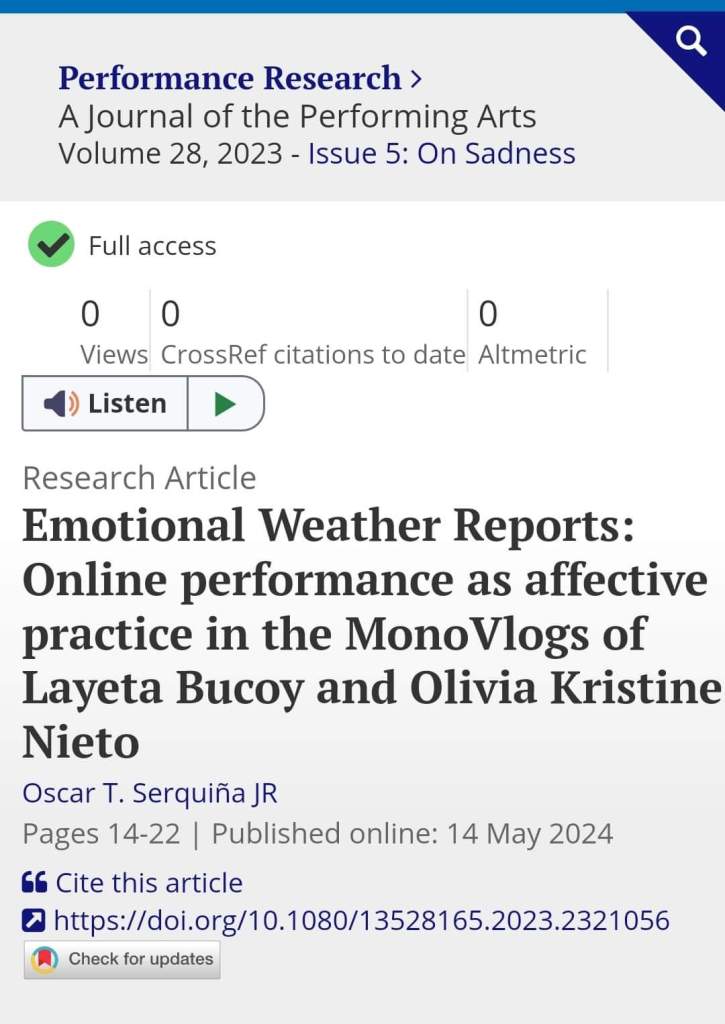
Congrats, Oscar Tantoco Serquiña! And thank you for believing in me to continue experimenting with the genius and generous Layeta Pinzon Bucoy since day 1!
Now, we need new parameters for emerging forms!
New reading for Contemporary Performance Practices. Download OJ’s article here.
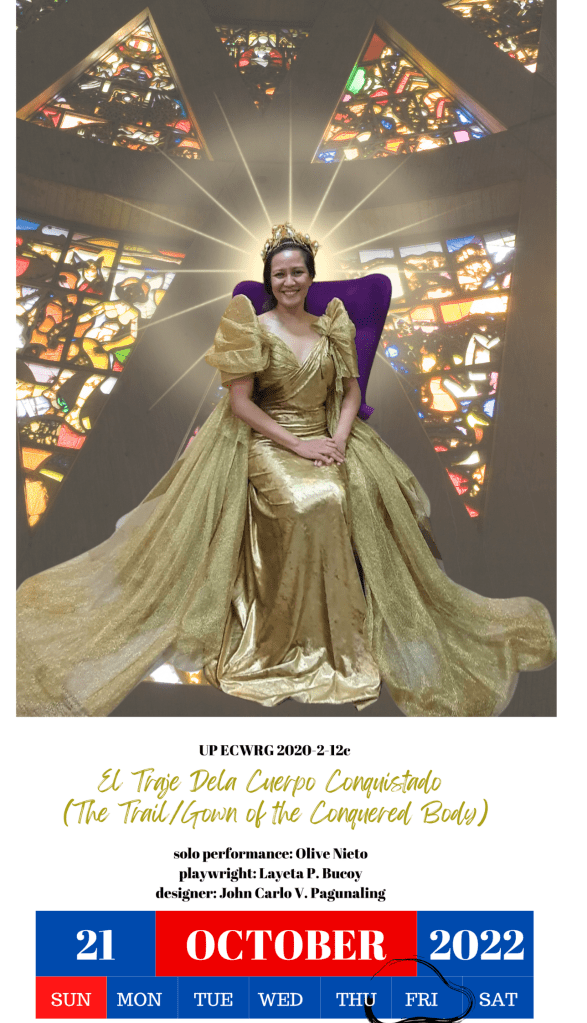
El Traje Dela Cuerpo Conquistada (The Trail/Gown of the Conquered Body)
Trilogy:
El Cuerpo (Noli Me Tangere’s Kabanata 26: Bisperas ng Piyesta) Fantasma (Noli Me Tangere’s Epilogo) Secreta Vida (MonoVlog)
The performance is funded by the University of the Philippines’ Enhanced Creative Work and Research Grant.
El Traje is a work in progress. We have 3 scholars reviewing the work this October to give comments and recommendations to our team. We are still looking for additional funds to translate and place captions in English, and to adapt the digital performance to an on-site performance (as originally envisioned in 2020).
*Special thanks to Ige Ramos and Michael Bernal for your brains and generosity.
Synopses
El Cuerpo is a solo digital performance centered on Panchang, a veil maker and performer in religious plays whose life is bound to the annual fiesta honoring the town’s patron saint. Sponsored by the gobernadorcillo, Panchang’s ritual performance has long been believed to sustain communal faith and invoke miracles. As a new theatre troupe—Komedya ng Tundo, trained by foreigners and favored for its novelty—rises in popularity, Panchang confronts the possible erasure of her labor, her body, and her tradition.
Staged during the pandemic, the performance parallels Panchang’s displacement with the performer’s own experience of shifting from stage-based theatre to online performance. Scenes unfold through fragmented digital tableaux, dramatic and staged readings, and close-up gestures framed by the camera. Incomplete costumes, found household objects, and improvised spaces function not as substitutions but as dramaturgical agents, exposing the labor and precarity behind performance-making.
As Panchang insists on repetition—performing not for innovation but for continuity—El Cuerpo interrogates what theatre is allowed to become in moments of rupture. The piece positions the performer’s body as a crossroads of ritual, failure, and adaptation, revealing how tradition and experimentation coexist within a changing performance ecology.
Fantasma is a solo digital performance adapted from the epilogue of José Rizal’s Noli Me Tangere, reimagined through the isolation of the pandemic and the politics of women’s visibility. On a stormy night, Maria Clara appears on the roof of the convent, crying out against the violence of hypocrisy that has enclosed her life. Long venerated as the ideal Filipina—pure, silent, and saintly—Maria Clara is stripped of her pedestal and reinhabited as a fractured, speaking body.
Performed through digital frames and fragmented lighting, Fantasma uses a handheld flashlight as a moving spotlight to reveal and conceal parts of the body, questioning who decides what of a woman’s body is shown, hidden, or sanctified. The performer’s brown body disrupts the colonial image of Maria Clara, exposing the labor and repression beneath her polished archetype.
The performance mirrors the solitude of pandemic-era digital theatre and foregrounds solo performance as both necessity and resistance. Fantasma asks whose stories are legible in digital space and reframes haunting as an act of reclamation—where the ghost refuses silence and insists on presence.
Secreta Vida is a solo digital performance staged as a MonoVlog—a hybrid of performance-lecture and rant vlog—that exposes the hidden labor, pressures, and contradictions of creating theatre during the pandemic. Addressing the audience directly as co-thinkers, the performer reflects on the artistic research behind El Cuerpo and Fantasma, unfolding her process in a scripted–improvised monologue shaped by the aesthetics of online confession and critique.
Blending personal narrative with academic reflection, the performance reveals the demands of multi-hyphenated creation: performer, dramaturg, director, designer, and digital technician. The camera becomes both witness and judge as the performer navigates institutional expectations, platform precarity, and the emotional toll of continuous adaptation. As digital performances vanish under shifting social media policies, Secreta Vida questions authorship, legitimacy, and ephemerality in online theatre.
The work culminates in a self-reflexive acceptance of uncertainty, affirming performance as an evolving practice shaped by failure, iteration, and care for unseen audiences.
The Giving Tree ko talaga ang MonoVlog at siyempre si Layeta Pinzon Bucoy! As always, riot ang presentation, Lallie!
Tapos na ang IFTR presentation ng MONOVLOG: VIRUS, VIRAL, VARIANT IN DIGITAL THEATRE IN THE PHILIPPINES. May future po ang ganitong timpla ng MonoVlog sa world (world congress kasi ito. Haha). Sinuot ko yung filipiniana bolero ni Debbie na gamit ko rin sisa sa mga MonoVlog.
Special mention ang mga gawa ng kaibigan na performance:
Fighting for Life:Embodiments of Suffering, Survival, and Solidarity in Pandemic-Stricken Philippines
The COVID-19 outbreak has put the Philippines at an unprecedented standstill. At the height of the health crisis in 2020, Philippine President Rodrigo Duterte implemented castigatory measures to keep Filipinos at bay and with the view of stemming contagious transmissions. Currently, the Philippines has one of the most dragging lockdowns in the world. It is also a hothouse of the virus in Southeast Asia. These realities have taken a toll on the individual and collective lives of Filipinos, who continue to face the national consequences of COVID-19, such as rising unemployment rates, increasing number of infections, and ballooning prices of market commodities.
In spite of these challenges, however, many Filipinos do not simply ride the tide. Different artistic communities, religious groups, civic organizations, and social movements deploy diverse practices to put up a fight and chronicle the social histories of their time. This panel offers perspectives on how Filipinos tap into a range of linguistic repertoires, social media networks, and communicative and performative acts in order to register their responses to their critical conditions. Highlighted in the following four presentations are Filipino bodies in constant motion and action, even while locked up in the (dis)comforts of their respective homes, particularly in online spaces which serve as the stages for their differently configured performances. This panel demonstrates that Filipinos dynamically work along and against a pandemic and the ongoing mayhem it has wrought in the domestic affairs of a nation placed, now more than ever, in protracted states of emergency.
Filipinos on the Line:
Going Viral as a Mode of Collective Endurance in the Age of COVID-19?
Oscar Tantoco Serquiña, Jr.
The intersection between the virality of COVID-19 and the virulence of politicians like President Rodrigo Duterte has brought new tribulations to the Filipino people, while at the same time throwing into stark relief the longstanding social, political, and economic challenges besetting the Philippines. These unprecedented conditions have instigated numerous tactics of survival, creative expression, and resistance specifically among performing artists who continue to commit themselves to the ongoing fight for social justice. This paper highlights a gamut of individuals, organizations, and institutions in and beyond the Philippines that have maximized online platforms in order to stage their rhetorical and embodied responses to a generation-defining period and phenomenon rife with political and pathological risks. It underscores the role of performative spaces such as the Internet not only in documenting everyday contemporary life but also in offering more humane modes of surviving the current or any forthcoming period of crisis.
Oscar Tantoco Serquiña Jr. is Assistant Professor in the Department of Speech Communication and Theatre Arts at the University of the Philippines. Currently, he is a PhD candidate in the School of Culture and Communication at the University of Melbourne. His essays have appeared in Theatre Research International, Performance Research, Humanities Diliman, Kritika Kultura, the Philippine Political Science Journal, and the Philippine Humanities Review.
MonoVlog as a Protest from Home Movement
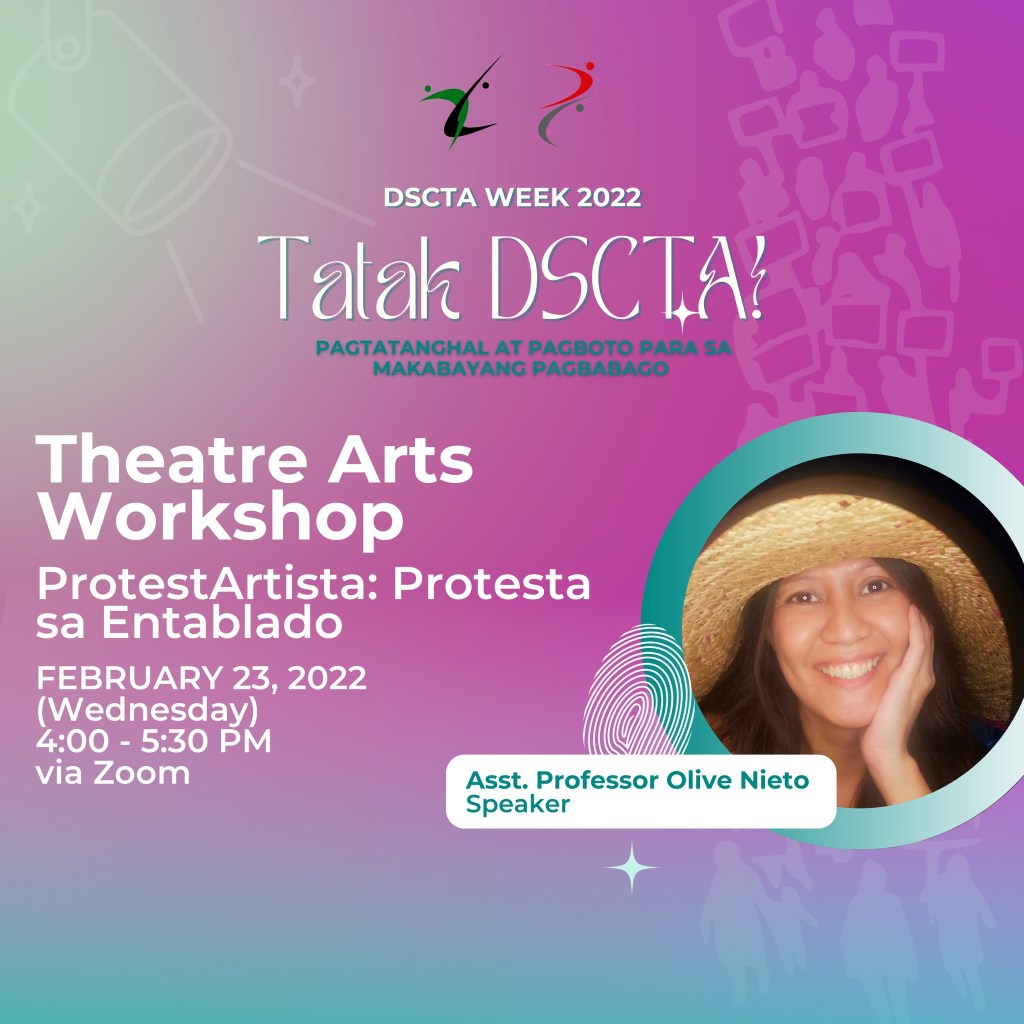
Olivia Kristine D. Nieto
This paper explores the aesthetics and sociality of the MonoVlog (a coinage that contracts the terms “monologue” and “vlog”) whose creation took place when Filipinos turned to the Internet to exercise free speech and creative expression in the time of enforced lockdown during the COVID-19 pandemic. This genre of online performance bundles the various Filipino lockdown experiences as a proof of life, a private conversation in social media, a health advisory, a tribute to frontliners, a death folder, a shout-out to advocacy groups, a community-led response to the pandemic, and a call for help. The art form not only creates a digital archive of the ways in which Filipinos live and lead their lives in intimate communities; additionally, it publicizes the conditions of work and emotional labor of Filipino performance makers who are also within these local communities. In the end, the MonoVlog is an emergency response of performance makers and an emerging artistic form that makes a stand on current issues concerning the unequal distribution of resources and the conflicting social positionalities of Filipinos that the global pandemic and the national government’s response to it have brought forth.
Olivia Kristine D. Nieto is an assistant professor at the Department of Speech Communication and Theatre Arts, College of Arts and Letters, University of the Philippines Diliman. She is also a performance maker.
Hashtag Activism in the New Normal:
Sites of Contention and Acts of Citizenship in the Philippines under a pandemic
Charles Erize P. Ladia
Constrained physical mobility and suppressed oppositional action have become the new normal for democratization movements in the Philippines under a global pandemic. Under these current crises, social movements have turned to social media platforms and their corresponding affordances, such as hashtags, as viable sites for free speech and dissent. One of which, #MassTestingNowPH, called for the improvement of healthcare facilities, dissent to military approach to pandemic, and the implementation of free mass testing to the concerned population. This presentation examines how netizens enact their citizenship by claiming their rights, asserting their demands, and publicizing their responsibilities in the online space. Consequently, these acts of citizenship reveal the amorphous nature of social media and the capacity of netizens to strategize the space for their own advantage.
#MassTestingNowPh enables netizens to dissent, demand, and discuss illiberal health policies and exact accountability from those who instigate them. This process not only engenders performances of citizenship in online platforms but also transform social media spaces as sites of contention. This paper finds that social movements still employed traditional offline repertoires even in online spaces (e.g., spreading information about the cause, creating a community of supporters, and arguing against their opposition). But they have also introduced actions that are online specific, namely: establishing transnational democratization alliances, using multiple hashtags, mobilizing people to do online actions and promoting use of scientific data as evidence. This new site of contention is where netizens symbolically converge, collectively brainstorm, and, even more importantly, proactively come up with alternative proposals and policies they deem beneficial to the Filipino people. In doing so, netizens crucially redefine what it means to be a Filipino citizen amidst undemocratic health policies and draconian attacks on resistive voices and bodies.
Charles Erize P. Ladia is an assistant professor of speech communication and rhetoric at the Department of Speech Communication and Theatre Arts, College of Arts and Letters, University of the Philippines Diliman. He earned his BA (Speech Communication) from UP Diliman and his Master of Public Management from the University of the Philippines Open University. Currently, he is pursuing PhD in Political Science and he is doing research on public addresses, political rhetoric, gender communication, social movements, and youth civic engagement.
As we gather (online): Covid-19 and Protestant church rituals
Junesse Crisostomo
Faith and religion are often considered important resources for resilience and survival during times of crises. The COVID-19 outbreak, however, has affected even the ways in which religious messages are regularly transmitted. Governments across the world, for instance, have temporarily halted public church events and practices that can prospectively contribute to the spread of the virus. In the Philippines, most churches transferred their rites of faith to online sites primarily to comply with the lockdown measures implemented by the government and to keep congregations safe. This transportation/transformation of sacred acts and rituals to cyberspace gives light to how churches perform the legitimization of their views on the scientific and political dimensions of the COVID-19 crisis.
This paper will look at how the COVID-19 pandemic is rhetorically constructed by three Protestant local churches in the Philippines. The artifacts of the study are statements, sermons, interview transcripts with pastors and parishioners, and participant observation notes that offer insights to the churches’ views on the COVID-19 pandemic and to the ways they perform their responses to it. This paper pivots around the following questions: How are these rhetorical constructions translated into embodied (and) online performances? How do these changes contribute to a performance theology of a “new normal” in spaces of worship, member participation, and church growth? This paper argues that the rhetorical performances of churches during the pandemic have a crucial role in shaping the public’s embodied responses in coping with the crisis and in acting out their faith.
Junesse Crisostomo is a faculty member of the Department of Speech Communication and Theatre Arts, University of the Philippines-Diliman. She recently finished her MA Communication degree with the UP Department of Communication Research through which she wrote her Master’s thesis on the role of the organizational rhetoric of the United Church of Christ in the Philippines (UCCP) in shaping political participation during the Duterte administration. Ms. Crisostomo has also presented research in rhetoric and performance studies at academic conferences in the Philippines and abroad, and has published works on social drama, religious hashtags, and politics in Humanities Diliman and Plaridel.










 Olive Nieto